“`html
Understanding the Intricacies of 3D Printing Technology
3D printing technology has revolutionized the way we conceptualize manufacturing and design. Known for its precision and adaptability, 3D printing, or additive manufacturing, converts digital files into three-dimensional physical objects by laying down material in successive layers. This article explores the mechanisms of 3D printing by delving into the processes, software essentials, industry uses, diverse technologies, material options, and services surrounding this innovative technology. From the basics of creating 3D models using specific software to slicing and understanding the different types of printing technologies like Vat Photopolymerisation and Powder Bed Fusion, we unravel how 3D printing is impacting multiple sectors, including automotive, healthcare, and even culinary arts. As you read, you’ll gain insights into how 3D printing is bridging gaps between digital concepts and tangible reality across various industries.
How Does 3D Printing Work?
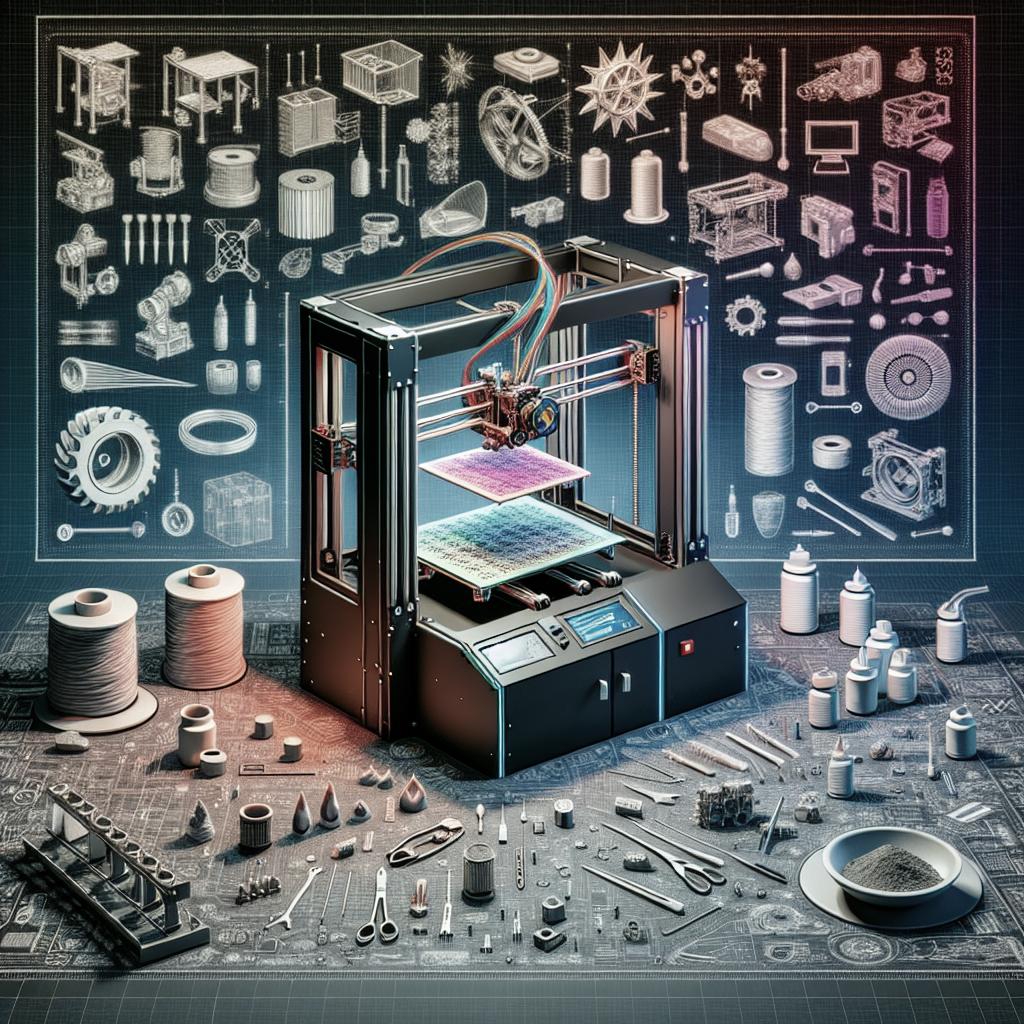
At its core, 3D printing is an additive manufacturing process that creates a physical object from a digital design. The process begins with a computer-aided design (CAD) model or a digital 3D model created using specialized software. This model acts as a blueprint guiding the 3D printer’s operations.
The printer constructs the object layer by layer. It deposits material, which can range widely in composition and form depending on the type of printer and desired properties of the final product. Unlike traditional manufacturing techniques which often involve cutting away material to reach the final form (subtractive manufacturing), 3D printing builds an object by successively adding layers.
3D Software
The foundation of any 3D print is the digital model—the blueprint of the item to be printed. These models are typically created using CAD software, which allows designers to manipulate virtual objects and save them in STL (Stereolithography) or OBJ formats. Popular CAD software options include SolidWorks, AutoCAD, and Blender, each offering varying tools tailored to different industries.
Once the design is complete, engineers or designers use software to optimize the model for 3D printing, adjusting features like the model’s scale, supports, and internal geometry. These adjustments ensure the model is not only printable but also maximizes material use and structural integrity.
Slicing: From file to 3D Printer
Slicing software interprets the digital file of a 3D model and converts it into instructions a 3D printer can follow—layer by layer. The process involves dividing the model horizontally into numerous thin layers, generating a G-code file that guides the printer. G-code tells the printer the path each layer should follow as well as the parameters like speed, temperature, and material flow.
Popular slicing software includes Cura, PrusaSlicer, and Simplify3D. These tools also provide settings to manage the infill density, which impacts the strength and weight of the object, support structures for overhanging elements, and various other print settings to optimize the quality and efficiency of the print process.
3D Printing Industry
The 3D printing industry has expanded significantly over the past decades. Initially reserved for prototyping and research and development, it’s now widely used in mainstream manufacturing and design. The technology enables rapid iteration, customization, and in some circumstances, a cost-effective alternative to traditional processes for small production runs.
As the industry grows, new applications arise; from large-scale construction to producing small, intricate parts for watches or medical devices. What stands out is the versatility that 3D printing offers—capable of working with a diversity of materials and scales—cementing its status as a transformative force across various sectors.
Examples of 3D Printing
Rapid Prototyping & Rapid Manufacturing
3D printing excels in rapid prototyping and manufacturing, providing engineers and designers the ability to quickly realize a tangible prototype. This reduces the time between iterations of designs, allowing for swift testing, evaluation, and adjustments prior to mass production.
This not only accelerates the product development lifecycle but also opens up opportunities for custom manufacturing. Companies can produce limited runs of products designed specifically for individual customers with minimal additional cost, expanding the scope for bespoke items.
Automotive
Automotive manufacturers have adopted 3D printing to quickly and cheaply produce car parts, from prototypes to production models. Companies like Ford and BMW utilize 3D printing to create complex geometries lighter than their traditionally-manufactured counterparts, thereby improving vehicle performance and fuel efficiency.
Additionally, 3D printing is employed for creating specialized lightweight tools that help streamline assembly lines, improving the ergonomics for workers and increasing productivity.
Aviation
The aviation industry benefits significantly from 3D printing technology as it enables the production of lightweight, durable parts. Companies like GE Aviation use this technology for parts like fuel nozzles, which traditionally required multiple components but can now be printed as a single piece, enhancing strength and efficiency.
Furthermore, the ability to produce on-demand spares reduces inventory costs, improving supply chain efficiency while ensuring components are readily available when needed.
Construction
In construction, 3D printing offers solutions for automating building processes, speeding up construction time while cutting costs. Large-scale printers can produce structural components or even entire buildings using concrete or specialized construction material, with enhanced precision and reduced waste.
This opens up innovative architectural possibilities and provides solutions to housing shortages by simplifying and expediting the building process.
Consumer Products
The consumer products sector taps into 3D printing for customized items ranging from footwear to jewelry. Customers can tailor products to personal specifications, with companies like Adidas experimenting with 3D-printed midsoles to push customization into mainstream retail.
The ease of customization and low-medium volume production runs foster an environment where individuals can take part in the design process, enhancing customer satisfaction and uniqueness of personal products.
Healthcare
Healthcare sees tremendous impact from 3D printing via the production of medical devices, prosthetics, and even bioprinted tissues. It allows the customization of implants tailored to patients’ anatomy, improving fit and function.
Furthermore, the ability to rapidly prototype and adapt medical instruments enhances surgical planning and outcomes, while researchers continue to explore bioprinting’s potential to create transplantable organs, marking new frontiers in medical science.
Food
The concept of 3D-printed food may sound futuristic, but it’s already happening. By using edible materials, 3D printing can create intricate shapes and designs previously impossible with traditional cooking methods.
This technology is paving the way for innovative culinary experiences, enabling the customization of texture, taste, and appearance, to provide personalized meals, with the potential for widespread application in restaurants and beyond.
Education
In education, 3D printing acts as a practical teaching tool, serving subjects like STEM where physical models enhance understanding. Students gain hands-on experience with designing and producing objects, bridging theoretical knowledge with real-world applications.
It promotes creativity and innovation, encouraging students to explore design thinking and problem-solving roles that are vital as technological industries continue to expand.
Types of 3D Printing Technologies and Processes
Vat Photopolymerisation
Vat Photopolymerisation uses a vat of liquid resin photopolymer, which is cured using a light source. During the build process, a platform is submerged in the vat, with the printer selectively curing layers of the resin and solidifying them to create each section of the object.
Technologies like SLA (Stereolithography) and DLP (Digital Light Processing) fall under this category, known for high precision and smooth surface finishes, making them suitable for industries needing intricate detail such as fashion jewelry and dental appliances.
Material Jetting
Material Jetting involves droplets of material being deposited layer upon layer, hardening into the final object. It functions similarly to a traditional inkjet printer but instead of ink, it uses build materials like polymers or waxes.
This technique is celebrated for its ability to achieve high detail and smooth surfaces, and it allows for the creation of multi-material and multi-color parts within a single print job, widely used in consumer goods and healthcare.
Binder Jetting
Binder Jetting prints compartments are created by placing layers of powdered material, which are selectively bonded by a liquid binder. The process builds the object layer by layer, with the unbound powder acting as support.
This method is advantageous for non-metallic applications, including full-color prototypes or models, and allows for large build sizes not practical with other technologies, enhancing its niche in educational and decorative applications.
Material Extrusion
Material Extrusion is one of the most commonly recognized 3D printing processes, featuring Fused Deposition Modeling (FDM). The approach involves a filament of solid material being heated and extruded through a nozzle, which deposits the melted material layer by layer to form the object.
Known for its reliability, affordability, and ability to work with a variety of thermoplastics, Materials Extrusion is favored in both commercial and hobbyist applications for producing functional parts and prototypes.
Powder Bed Fusion
In Powder Bed Fusion, fine powders are melted or partially melted by a heat source to form solid layers. Each layer of powder is uniformly spread over the previous layer, followed by the system’s energy source fusing the material together.
Technologies such as SLS (Selective Laser Sintering) and DMLS (Direct Metal Laser Sintering) fall into this category, popular in the aerospace and medical industries, offering strength, complexity, and durability often required in demanding applications.
Directed Energy Deposition
Directed Energy Deposition involves material being deposited simultaneously with an energy source, like a laser or electron beam, which fuses the material as it is being deposited. This technology is characterized by adding material to existing parts, commonly used in repair and maintenance applications.
It allows for controlled placement of materials, making it advantageous for complex repairs, refurbished titanium parts, and components that require different materials to be deposited at various points.
Materials
The choice of materials in 3D printing is immense and continues to grow. Options range from plastics like ABS and PLA to metals, ceramics, and even edible substances. Each material presents distinct advantages: plastics offer flexibility and are cost-effective; metals provide strength and durability for industrial use.
Composite materials are also gaining traction, merging benefits of different substances into one cohesive material offering unique properties. The diverse range of materials means that 3D printing can be tailored to specific industry needs, enhancing versatility.
Services
With the expansion of 3D printing capabilities, tailored services have emerged for businesses and consumers alike. Service providers offer prototyping, design, and production services, enabling clients without their own 3D printers to benefit from this technology.
Many companies operate 3D printing farms—large-scale operations where numerous printers are set up to handle arrays of orders simultaneously, offering rapid batch production capacity. This accessibility means even small businesses can leverage 3D printing, scaling their offerings without substantial upfront investment.
Summary of Main Points
| Aspect | Key Points |
|---|---|
| How does 3D Printing Work? | Layer-by-layer fabrication from digital models, utilizing various material deposition methods. |
| 3D Software | Key step in creating and preparing digital models for printing. |
| Slicing | Converts 3D models into instructions for printers, detailing layers, speed, and settings. |
| 3D Printing Industry | Expansive applications across diverse sectors including healthcare, automotive, and construction. |
| Examples of 3D Printing | Includes rapid prototyping, consumer products customization, and innovative industries like aviation and food. |
| 3D Printing Technologies | Varied processes like Vat Photopolymerisation, Material Extrusion, and Directed Energy Deposition. |
| Materials | Range from plastics and metals to composites and edibles, offering properties and applications suited to various needs. |
| Services | Comprehensive service offerings facilitating access to 3D printing for diverse client needs. |
“`